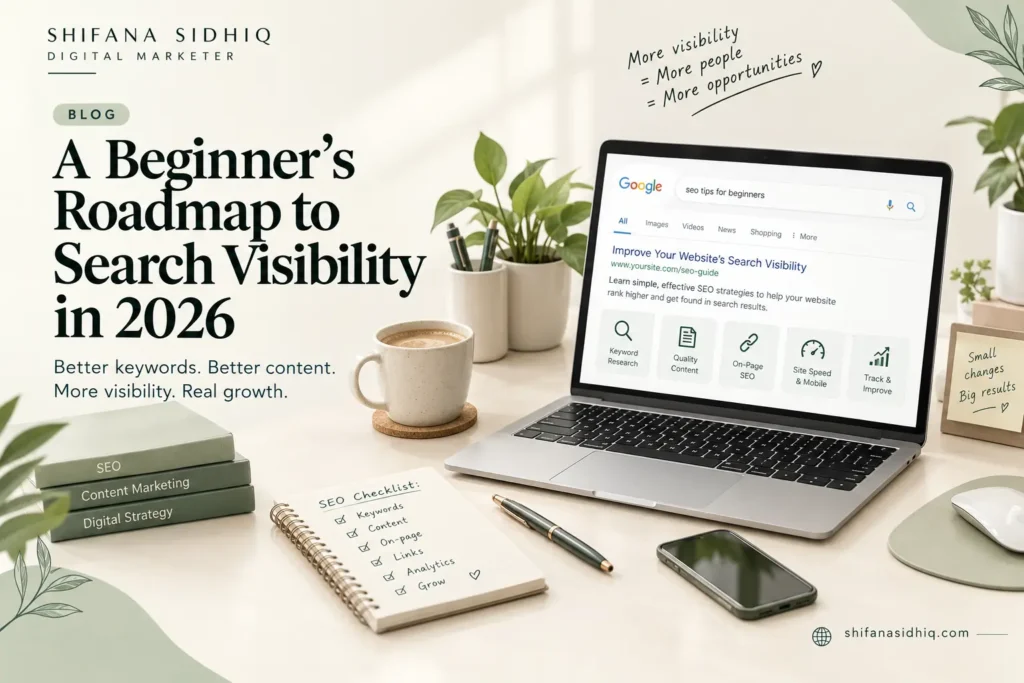
SEO strategies for beginners in 2026 start with keyword research, helpful content, and a website that is easy for visitors to navigate. Building a website is the easy part. Getting strangers to find it is harder. You might have knowledge, products, or services that people need, but if your pages don’t surface when they search, most of those people will never know you exist.
Search engine optimization (SEO) is the discipline of making your site easier for search engines to read and easier for people to use, so it earns a place in organic, unpaid results. You don’t need an engineering background to start. A handful of basic habits, practiced consistently, will take you further than any single trick.
In essence, SEO means making a page legible to crawlers while making sure the person who lands on it finds exactly what they were looking for. Picture someone typing a request for a local tutor who teaches chemistry. A tutoring website that spells out its subjects, shares study resources people can actually use, and makes its contact details easy to find will surface for those searches far more often than a vague homepage with no real detail.
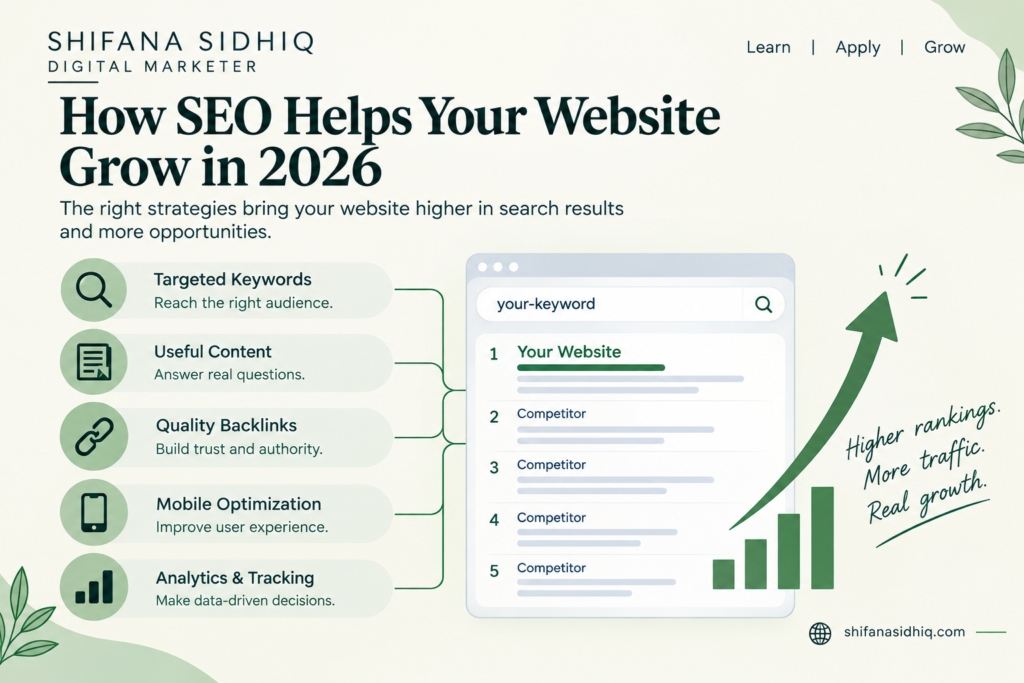
The benefits of SEO become visible in several ways. Search engines can show your content for relevant search terms, helping people find the products or services they need. Helpful content may continue attracting organic visitors long after publication. A well-organized website also makes it easier for readers to explore your pages and find useful information. Each appearance in search results creates an opportunity to connect with potential customers or readers.
However, SEO takes time, patience, and consistent effort. SEO strategies for beginners in 2026 focus on understanding search intent, choosing relevant keywords, and publishing useful content. Applying these practices regularly can improve your website’s search visibility, help search engines discover your pages, and support long-term organic growth.
Before you write anything, figure out what your audience is actually typing into a search bar. Broad words like “marketing” are crowded and vague. A phrase such as “simple SEO checklist for a bakery website” tells you much more about the person searching and what they need.
Think about your audience’s problems, questions, and vocabulary. Google’s autocomplete suggestions and “related searches” section are free sources of real phrasing. Keyword tools can add data on search volume and competition, but treat those numbers as estimates rather than facts.
Beginners usually do best with longer, more specific phrases, since they face less competition. Still, verify demand before committing. For each page, pick one primary keyword and weave in related terms where they fit naturally. Dropping the same keyword into each paragraph sounds robotic to readers and can make the text harder to follow. SEO strategies for beginners in 2026 work best when you choose relevant keywords based on what your audience is searching for.
Your pages give search engines the evidence they need to assess your website, and they give visitors the reason to keep reading or leave. Both reward pages that answer a question well.
Start by deciding what question the page answers. Then shape the piece around it: a clear introduction, sections with descriptive headings, and a conclusion that gives the reader something to do next.
Explain ideas in everyday words and illustrate them with real cases instead of heavy technical jargon. Add something a reader couldn’t easily get elsewhere, such as your own experience, a small test you ran, or a worked example. AI tools can help you draft, but a draft is not finished until a person has checked its accuracy and added real insight. Publishing generic text that merely restates what already ranks rarely earns trust.
In 2026, write for the person reading, not for a keyword count. SEO strategies for beginners in 2026 should prioritize helpful information and a smooth experience for every website visitor.
On-page SEO means making each page’s elements clear to both machines and humans.
Your title should give an accurate picture of the page’s content, and where it makes sense, the main keyword should appear toward the beginning. Keep it readable. A title stuffed with modifiers looks spammy and often gets rewritten by search engines anyway.
The meta description is a short summary that can influence whether some
one clicks. It isn’t a direct ranking factor, but it shapes what searchers expect to find. Write it as a plain, honest promise about the page.
Work your primary term into several key locations, including the headline, the first paragraph, a section heading where it reads well, the page address, and the summary shown in search results. A slug like /seo-basics-small-business-2026/ is easy to read and tells both users and crawlers what to expect.
Images deserve attention too. When an image carries information, give it descriptive alt text that explains what it shows. Alt text is for accessibility and context first, so don’t force keywords into it. One of the most practical SEO strategies for beginners in 2026 is to optimize page titles, meta descriptions, headings, and image alt text while keeping the content natural and easy to read.
Performance affects both rankings and whether visitors stay. People frequently abandon a slow or clumsy page before they get to the opening lines.
Check your website on a mobile phone first. The text should be easy to read, buttons should be simple to tap, and important information should be easy to find. You can also improve performance by compressing large images, removing unused plugins, choosing reliable hosting, and enabling caching when available.
Website performance is an important part of SEO strategies for beginners in 2026. Regularly testing your website helps you identify slow pages, navigation problems, and mobile usability issues. Fixing these problems can create a smoother browsing experience, encourage visitors to explore more pages, and support your website’s overall search visibility.
Internal links connect pages on your site. They help visitors move to related material and help search engines discover and understand your content.
If you write a guide to choosing keywords, link it to your article on writing page titles. If you offer a service that a blog post touches on, link the post to that service page when the connection is genuinely useful to the reader.
Anchor text should tell people where the link goes, such as “our guide to meta descriptions,” rather than a vague “click here.” Every link should serve a reader’s next step. Scattering links just to raise their count does more harm than good. Over time, a sensible linking structure also groups related articles into clusters on a shared topic, which makes your site easier to navigate.
Outbound links point readers to material on other sites. When you cite a claim, linking to a credible source lets readers verify it and explore further. An article about search performance, for example, can point to Google’s official Search Central documentation.
Outbound links are not a shortcut to better rankings. Their job is to support your content. Backlinks from other sites work differently: when a relevant site links to you because your page is genuinely useful, that signals value. Pursue those links by making resources people want to reference. Paid link schemes and mass link exchanges carry real risk and rarely last. For more information about SEO, read the Google Search Central SEO Starter Guide to learn how search engines discover and understand website content.
SEO doesn’t end at publication. Google Search Console is the best free starting point, showing impressions, clicks, click-through rate, and average position for your pages. Google Analytics adds detail about how visitors behave once they arrive.
Read these numbers as diagnostics. If a page earns impressions but few clicks, its title or description may not promise enough value. If people arrive and leave quickly, the content may not match their intent, or the page may be hard to navigate.
Be careful about treating rankings as the only scorecard. Depending on your goals, qualified visits, inquiries, sign-ups, and sales may matter more. Also keep expectations realistic. Changes can take weeks or months to register, and no agency or tool can guarantee a specific position. Tracking results regularly helps beginners understand which SEO strategies for beginners in 2026 are bringing relevant visitors to their websites.
If your customers come from a particular town or region, local SEO deserves extra attention. Someone looking for a plumber, a tutor, or a designer nearby is often ready to act quickly.
Start by setting up a complete Google Business Profile, if you qualify. Enter accurate details, choose appropriate categories, and keep hours and contact information current. Describe the areas you serve on relevant pages and explain your services in practical terms.
Ask satisfied customers for honest reviews where it’s appropriate, and reply to feedback, including criticism, professionally. Keep your business name, street address, and phone number identical on every website and listing where they show up. Local SEO is about being a clear, trustworthy answer for people nearby, not about repeating a city name on every page
If you’re looking for a digital marketing expert in Malappuram, explore my services to learn how SEO, social media marketing, Google Ads, and Meta Ads can help your business grow online. Keyword stuffing is the most common error. Repetitive text reads poorly and can work against you. Use keywords where they fit and focus on the reader’s question.
Publishing in volume without checking accuracy or usefulness is another trap. A modest number of well-developed pages tends to do better than a large collection of shallow ones. Many sites also neglect the basics: mobile usability, broken links, and outdated information. Reviewing your key pages periodically keeps them working.
Finally, don’t expect instant results. Search engines weigh many signals, and nobody can promise a number-one spot. Following SEO strategies for beginners in 2026 consistently can help you avoid common mistakes and improve your website over time.
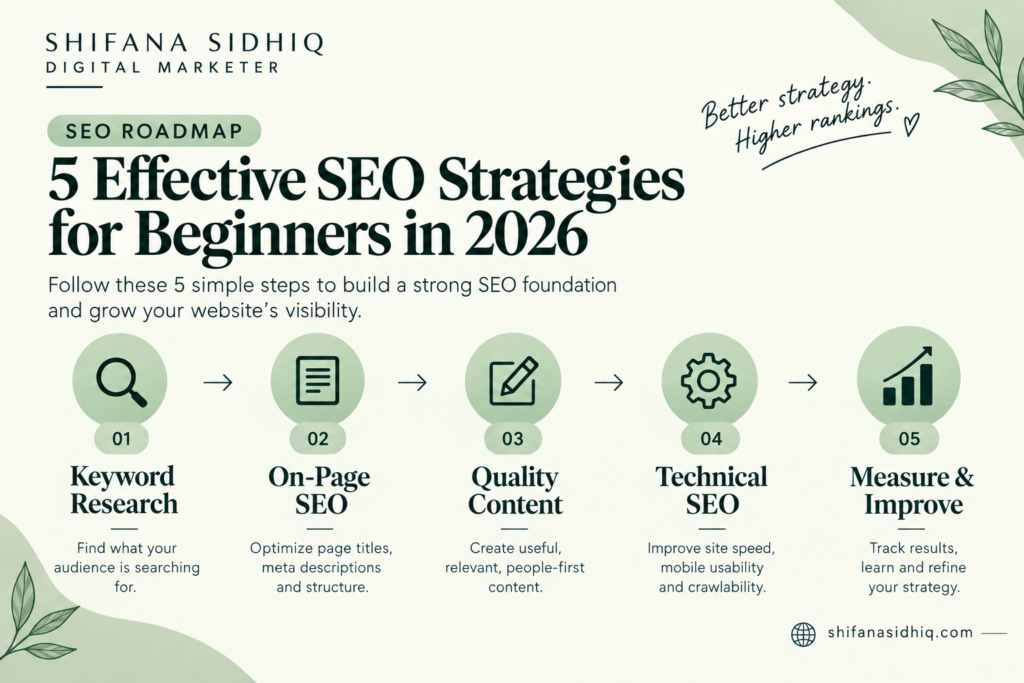
SEO becomes manageable when you take it one step at a time. Start with keyword research for your most important pages and create content that answers real questions. Improve your titles, meta descriptions, and headings, and make sure your website works well on mobile devices. As your website grows, add relevant internal links, refer to trustworthy sources, and review your results in Google Search Console regularly.
There’s no need to complete every task at once. Focus on the improvements that matter most to your audience and your goals. By following SEO strategies for beginners in 2026, you can improve your website’s search visibility, attract relevant visitors, and create a better experience for your audience. Start with useful content, relevant keywords, technical improvements, and regular performance tracking to strengthen your website’s long-term search performance.
Search Engine Optimization (SEO) is the process of improving a website so that it can appear more prominently in search engine results. It helps businesses attract relevant visitors, improve online visibility, and reach people who are searching for their products or services.
Beginners can start by learning keyword research, creating helpful content, optimizing page titles and meta descriptions, and improving website navigation. Using Google Search Console can also help you understand how your website performs in search results.
SEO usually takes several weeks or months to show noticeable improvements. The timeline depends on competition, website quality, content relevance, and the work involved. Consistent optimization is important for long-term progress.
Useful strategies include researching relevant keywords, publishing original and helpful content, optimizing headings and page titles, improving mobile usability, building relevant internal links, and monitoring website performance.
On-page SEO involves improving elements on your website, such as content, headings, URLs, and internal links. Off-page SEO focuses on activities outside your website, such as earning relevant backlinks and building your website’s reputation.
Yes. Keyword research helps you understand what people search for and what information they need. Choosing relevant keywords makes it easier to create content that matches search intent and attracts the right audience.
Yes. Local SEO helps businesses improve their visibility for location-related searches. Keeping business information accurate, optimizing relevant website pages, and maintaining a complete Google Business Profile can help eligible businesses connect with nearby customers.
Start by checking your website using Google Search Console. Review search impressions, clicks, and indexing issues. Then improve underperforming pages, create useful content, fix technical problems, and add relevant internal links.
Internal links connect one page of your website to another. They help visitors discover related information and help search engines understand your site’s structure. Use descriptive anchor text and link to pages that genuinely support the reader.
You can learn and apply basic SEO techniques yourself. However, a digital marketing expert can help you develop a strategy, identify optimization opportunities, and manage SEO alongside other digital marketing activities. If you need local support, you can explore my digital marketing services in Malappuram.